Introduction
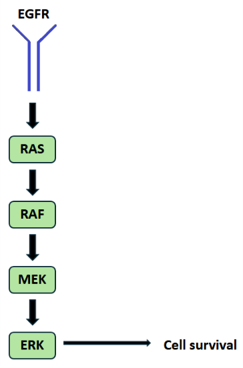
B-raf (BRAF) proto-oncogene mutations exist in approximately 10-12% of colorectal cancers (CRC), with the variant V600E accounting for the vast majority of these mutations.1,2 BRAF mutations lead to constitutive activation of the mitogen-activated protein kinase (MAPK) pathway, regardless of epidermal growth factor receptor (EGFR) activation, resulting in overgrowth of cancer cells (figure 1).
Figure 1: MAPK Pathway1
In addition to this role in tumorigenesis, BRAF mutations also have several prognostic implications, including poorer survival compared to BRAF-wild type cancers (particularly in metastatic disease), poorly differentiated histology of cancer cells, metastases to sites that are less amenable to surgical resection, and a tendency toward right-sided tumors, conferring resistance to anti-EGFR targeted agents commonly used in CRC treatment.1-3
Due to these prognostic differences, BRAF blockade has long been studied for this subset of CRC in hopes of improved treatment outcomes. The BRAF-inhibitor vemurafenib was first studied in the treatment of BRAF-mutated CRC in 2010. However, BRAF inhibition alone was not hugely successful in CRC due to a physiologic response to upregulate EGFR activation with decreased extracellular signal-regulated kinase (ERK) activity resulting from BRAF inhibition.4,5
Efficacy of Combination Treatment
The BEACON CRC trial was the first, large phase III trial to successfully utilize a combination of BRAF, mitogen-activated protein kinase (MEK), and EGFR inhibitors to overcome feedback loops in BRAF-mutated CRC. It investigated the effectiveness of BRAF-inhibitor combination therapies compared to standard chemotherapy in combination with cetuximab in patients with BRAF V600E-mutated metastatic CRC after at least one previous line of therapy.6 This trial resulted in FDA approval of the doublet regimen encorafenib and cetuximab for previously treated, BRAF V600E-mutated metastatic CRC in April 2020.7
The BREAKWATER trial aimed to expand the use of BRAF-targeted combinations to the first line setting. The trial investigated the effectiveness of BRAF-inhibitor combination therapies compared to standard chemotherapy in previously untreated patients with BRAF V600E-mutated metastatic CRC. Results from this trial lead to the FDA accelerated approval of encorafenib in combination with cetuximab and leucovorin + fluorouracil + oxaliplatin (FOLFOX) in BRAF V600E-mutated CRC in December 2024.9 A protocol amendment added a new cohort to investigate the use of leucovorin + fluorouracil + irinotecan (FOLFIRI) instead of FOLFOX.10 Initial results from this cohort and updated data from the original BREAKWATER cohorts lead to the FDA approval for encorafenib and cetuximab in combination with any fluorouracil-based chemotherapy in February 2026.11 See Table 1 for a review of these trials.
Table 1. Combination therapy trials for BRAF-mutated CRC6,8,10
| Trial | Comparator Arms | Primary Outcome | Notable Secondary Outcomes |
| BEACON CRC |
1. Encorafenib + binimetinib + cetuximab (triplet) 2. Encorafenib + cetuximab (doublet) 3. Cetuximab + irinotecan +/- fluorouracil and leucovorin (control) |
Median overall survival (mOS): 9 months (triplet) vs. 8.4 months (doublet) vs. 5.4 months (control); P<0.001 for both combination arms compared to control |
|
| BREAKWATER |
1. Encorafenib + cetuximab (EC) 2. Encorafenib + cetuximab + FOLFOX (EC + FOLFOX) 3. Standard of care chemotherapy +/- bevacizumab (control) |
Median progression free survival (mPFS): 6.8 months (EC) vs. 12.8 months (EC + FOLFOX) vs. 7.1 months (control); P<0.001 for EC + FOLFOX vs. control |
|
| BREAKWATER Cohort 3 |
1. Encorafenib + cetuximab + FOLFIRI (EC + FOLFIRI) 2. FOLFIRI +/- bevacizumab (control) |
ORR: 64.4% (EC + FOLFIRI) vs. 39.2% (control); P=0.0011 |
|
Safety Considerations
The drugs included in the BREAKWATER regimens have their own set of possible adverse events as well as warnings and precautions. Some of these include neuropathy, gastrointestinal (GI) toxicity, bone marrow suppression, electrolyte abnormalities, and cardiotoxicity to name a few (Table 2). Additionally, adverse events can become cumulative as patients continue treatment. In the BREAKWATER trial, safety was assessed in both encorafenib + cetuximab + FOLFOX and encorafenib + cetuximab + FOLFIRI regimens. In those treated with encorafenib + cetuximab + FOLFOX, 81.5% of patients had a grade ≥ 3 adverse event occur compared to 66.8% in those that received standard care. The most commonly reported adverse events with encorafenib + cetuximab + FOLFOX were nausea, anemia, diarrhea, decreased appetite, vomiting, reduced neutrophil count, arthralgia, and rash. With standard care, diarrhea and nausea were the most reported.8 In those treated with encorafenib + cetuximab + FOLFIRI, grade ≥ 3 adverse events occurred in 70.4% of patients compared to 80.9% in those that received bevacizumab +/- FOLFIRI.10 With encorafenib + cetuximab + FOLFIRI, nausea, diarrhea, vomiting, anemia, alopecia, fatigue, decreased neutrophils, constipation, and decreased appetite were the most commonly reported adverse events. While nausea, diarrhea, vomiting, fatigue, decreased neutrophils, constipation, and decreased appetite were the most reported with bevacizumab +/- FOLFIRI.
Based on some of the warnings and known adverse events with these drugs as well as the safety data from the trial, not all patients may be a good fit for the BREAKWATER regimens. Patients with clinically significant cardiovascular diseases such as congestive heart failure, prolonged QTc, history of acute myocardial infarction, and history of acute coronary syndromes were excluded from the trial. Additionally, those with an ECOG Performance Status of greater than 1 were excluded. These regimens typically require several home anti-emetics, anti-diarrheals, and rash prophylaxis, increasing the risk of polypharmacy, especially in those who already take a lot of medications at home. Patients that have a cardiac history, are frail, or have concerns for polypharmacy and confusion, should be closely reviewed on whether they are a good fit for these regimens.
Table 2. Review of drugs included in the BREAKWATER regimens12,13,14,15,16
| Drug | Mechanism of Action | Adverse Events | Recommended Monitoring |
| Fluorouracil |
|
|
|
| Oxaliplatin |
|
|
|
| Irinotecan |
|
|
|
| Cetuximab |
|
|
|
| Encorafenib |
|
|
|
Discussion
The success of targeted therapy for BRAF V600E mutations has given patients and healthcare providers hope of a new, efficacious treatment option in a particularly aggressive subset of CRC. The landmark BREAKWATER and BEACON CRC trials demonstrated clearly superior efficacy outcomes in terms of survival and treatment response rates, ushering in a new era of BRAF-mutated CRC treatment.
Now the question arises, should this be the default approach or something that we use more selectively? The BREAKWATER regimens are recommended options for first line metastatic CRC in several guidelines.17 This addition is based on the trial results, but the decision to use is clouded by some of the potential risks previously discussed. In our practice, for patients that have a cardiac history, are frail, or have concerns for polypharmacy and confusion, our clinical teams consider the use of FOLFOX or FOLFIRI only in the first line setting. This leaves patients with the option to use encorafenib + cetuximab in the second line setting based on the data from the BEACON CRC trial, allowing them exposure to all standard drugs while maintaining safety and quality of life. If patients still decide to proceed considering those risks, our clinical teams recommend close monitoring and follow up.
When starting patients on one of the BREAKWATER regimens, it is important to account for pertinent monitoring and supportive care needs. The electrolyte abnormalities and rash that may develop with cetuximab require close attention. Magnesium is the most common electrolyte affected, and, as hypomagnesemia can be contributory to cardiovascular risk including QTc prolongation, serum magnesium level should be assessed with every treatment. Consideration should be given to incorporate an electrolyte replacement protocol within the patient’s treatment plan. Additionally, dermatologic prophylaxis is typically recommended with cetuximab due to the high risk for acneiform rash. This typically includes moisturizer and sunscreen twice daily, topical hydrocortisone 1% twice daily, and oral doxycycline 100 mg twice daily.18
Due to the risk of cardiomyopathy, ejection fraction monitoring is recommended prior to initiation of encorafenib, one month after initiation, and then every two to three months during treatment. Although there is risk for QTc prolongation, it is minimal, so monitoring is only recommended in those who are at an increased risk or who present with symptoms.
In conclusion, while the reported data from the BREAKWATER trial is practice changing, we need to carefully weigh the risks and benefits of these combination regimens for each and every patient prior to treatment initiation. Considerations should be given to comorbid conditions putting patients at increased risk for adverse events, frailty, and risk for polypharmacy issues. A collaborative approach between team members should be taken when having these treatment initiation discussions to ensure the best overall course for the patient.
References
-
Clarke CN, Kopetz ES. BRAF mutant colorectal cancer as a distinct subset of colorectal cancer: clinical characteristics, clinical behavior, and response to targeted therapies. J Gastrointest Oncol. 2015;6(6):660-7. doi: 10.3978/j.issn.2078-6891.2015.077
-
Grothey A, Fakih M, Tabernero J. Management of BRAF-mutant metastatic colorectal cancer: a review of treatment options and evidence-based guidelines. Ann Oncol. 2021;32(8):959-67. doi: 10.1016/j.annonc.2021.03.206
-
El Sayed M, Youssef S, Shealy MW III, El Harati M. Prognostic and clinicopathologic significance of BRAF mutation in colon cancer by MSI status and stage: A large cohort analysis. Surg Oncol. Preprint. Posted online April 3, 2026. doi: 10.1016/j.suronc.2026.102419
-
Kopetz S, Desai J, Chan E, et al. PLX4032 in metastatic colorectal cancer patients with mutant BRAF tumors [abstract]. J Clin Oncol. 2010;28(Suppl):Abstract 3534. doi: 10.1016/j.annonc.2021.03.206
-
Prahallad A, Sun C, Huang S, et al. Unresponsiveness of colon cancer to BRAF(V600E) inhibition through feedback activation of EGFR. Nature. 2012;483(7387)100-3. doi: 10.1038/nature10868
-
Kopetz S, Grothey A, Yaeger R, et al. Encorafenib, binimetinib, and cetuximab in BRAF V600E–mutated colorectal cancer. N Engl J Med. 2019;381(17):1632-43. doi: 10.1056/NEJMoa1908075
-
NCI Staff. National Cancer Institute. Encorafenib, cetuximab combination approved for metastatic colorectal cancer. https://www.cancer.gov/news-events/cancer-currents-blog/2020/fda-encorafenib-cetuximab-metastatic-colorectal. Published May 8, 2020. Accessed May 26, 2026.
-
Elez E, Yoshino T, Shen L, et al. Encorafenib, cetuximab, and mFOLFOX6 in BRAF-mutated colorectal cancer. N Engl J Med. 2025;392:2425-37. doi: 10.1056/NEJMoa2501912
-
FDA grants accelerated approval to encorafenib with cetuximab and mFOLFOX6 for metastatic colorectal cancer with a BRAF V600E mutation. U.S. Food & Drug Administration. https://www.fda.gov/drugs/resources-information-approved-drugs/fda-grants-accelerated-approval-encorafenib-cetuximab-and-mfolfox6-metastatic-colorectal-cancer-braf. Published December 20, 2024. Accessed May 26, 2026.
-
Kopetz S, Tabernero J, Lonardi S, et al. A randomised study of encorafenib, cetuximab, and FOLFIRI versus FOLFIRI with or without bevacizumab in BRAF V600E-mutant colorectal cancer: BREAKWATER Cohort 3. Ann Oncol. Preprint. Posted online May 31, 2026. doi: 10.1016/j.annonc.2026.04.017
-
FDA grants traditional approval to encorafenib for metastatic colorectal cancer with a BRAF V600E mutation. U.S. Food & Drug Administration. https://www.fda.gov/drugs/resources-information-approved-drugs/fda-grants-traditional-approval-encorafenib-metastatic-colorectal-cancer-braf-v600e-mutation. Published February 24, 2026. Accessed May 26, 2026.
-
Fluorouracil. Prescribing Information. Fresenius Kabi USA; 2026. Accessed June 11, 2026. https://editor.fresenius-kabi.us/PIs/US-PH-Fluorouracil_Inj-FK-45648K_Feb_2026-PI.pdf
-
Oxaliplatin. Prescribing Information. Hospira; 2024. Accessed June 11, 2026. https://labeling.pfizer.com/ShowLabeling.aspx?id=4558
-
Irinotecan. Prescribing Information. Pharmacia & Upjohn Company LLC; 2024. Accessed June 11, 2026. https://labeling.pfizer.com/ShowLabeling.aspx?id=533
-
Erbitux. Prescribing Information. ImClone LLC; 2021. Accessed June 11, 2026. https://uspl.lilly.com/erbitux/erbitux.html#pi
-
Braftovi. Prescribing Information. Array BioPharma Inc; 2026. Accessed June 11, 2026. https://labeling.pfizer.com/ShowLabeling.aspx?id=12990
-
Cremolini C, Chalabi M, Elez E, et al. Metastatic colorectal cancer: ESMO Clinical Practice Guideline for diagnosis, treatment and follow-up. Ann Oncol. 2026;37(6):759-76. doi: 10.1016/j.annonc.2026.03.005
-
Lacouture M, Ana M, Bensadoun RJ, et al. Clinical practice guidelines for the prevention and treatment of EGFR inhibitor-associated dermatologic toxicities. Support Care Cancer. 2011;19:1079-1095. doi: 10.1007/s00520-011-1197-6