Background on pancreatic cancer & RAS mutations
Pancreatic ductal adenocarcinoma (PDAC) is one of the most lethal cancers. In 2026, new diagnoses of PDAC will only comprise about 3.2% of all new cancer cases in the U.S. with about 67,530 patients diagnosed. However, it is expected that 52,740 patients will die of this disease, with only 13.7% of patients expected to be alive at five years.1 In the previously treated metastatic setting, the outlook is even more dismal. Subsequent-line treatment provides less than 10% response rates, with median overall survival (mOS) estimated at only five to seven months.2
Biomarkers as targets for anti-neoplastic therapy have been a boon for many disease states with poor prognosis such as non-small cell lung cancer and melanoma. Unfortunately, PDAC has not benefited from these targeted approaches.3 Even though it has been known that KRAS drives more than 90% of pancreatic cancers for almost four decades, it has been a notoriously undruggable target until recently.4 Briefly, KRAS mutations keep KRAS activated, which leads to downstream activation of pathways including RAF-MEK-ERK and PIK3-AKT-mTOR.3 Typically, small-molecule inhibitors target protein kinase pockets to compete with ATP binding. KRAS’s elusiveness mostly stems from the lack of well-defined pockets amenable to small molecules, due to relying on GTP as an activator rather than ATP. GTP binds at picomolar concentrations, compared to micromolar concentrations for ATP, constraining the space available for a small molecule to attach.
In 2013, a druggable pocket in RAS was discovered and the highly reactive nature of cysteine in the G12C mutation was exploited, eventually leading to the approvals of sotorasib in 2021 and adagrasib in 2022.5 These medications were a landmark innovation for patients with non-small lung cancer and colorectal cancer, however the G12C mutation only makes up about 1-2% of PDAC KRAS mutations. More common mutations include G12D (~40%), G12V (~30%), and G12R (~20%); therefore different approaches were needed for these patients.3 Enter the pan-RAS inhibitors.
Efficacy and safety of daraxonrasib
Sotorasib and adagrasib are limited in that they only target KRAS G12C, and only in the “off” position. Daraxonrasib was developed to target both mutant and wild-type KRAS, HRAS, and NRAS isoforms, as well as in the “on” position. Daraxonrasib forms a complex with cyclophilin A (CypA) after entering the cell. This complex has a high affinity for the active state of RAS, thus overcoming a once challenging barrier.6
In the phase 1/2 study RMC-6236-001, daraxonrasib was evaluated in patients with a variety of solid tumors with activating RAS mutations.2 Patients had to have received standard therapy for their disease and could not harbor a KRAS G12C mutation. Dose levels ranged from 10 mg to 400 mg orally once daily. The maximum tolerated dose was not formally reached, with the high frequency of dose reductions at 400 mg eliminating that as a dosing option. Dose expansion cohorts specifically in PDAC patients explored doses of 120 mg, 200 mg, and 300 mg. The 168 PDAC patients enrolled represented the typical demographic of diagnosed patients and received a median of two previous treatments (range, one to six). Median duration of treatment in the overall population was 5.7 months (range, 0.03 to 31.5 months). Treatment was discontinued in 150 of 168 patients (89.2%), primarily due to disease or clinical progression (114 patients total). The dose of 300 mg emerged as the optimal dose, and survival data were highlighted specifically for these patients. The mOS for patients receiving daraxonrasib 300 mg in the second- and third-line setting was 15.6 months and 9.0 months, respectively, showing an impressive numerical improvement over current survival data.
The results of the RASolute 302 trial increased widespread attention for daraxonrasib in the spring of 2026, even garnering a standing ovation of almost a whole minute at the 2026 ASCO Annual Conference.7,8 RASolute 302 enrolled patients with metastatic PDAC who had progressed on one previous line of an appropriate chemotherapy regimen. Previous chemotherapy regimens included mFOLFIRINOX or FOLFIRINOX (5-fluorouracil [5-FU], irinotecan, leucovorin [LV], and oxaliplatin), gemcitabine plus nab-paclitaxel, NALIRIFOX (liposomal irinotecan, oxaliplatin, and 5-FU/LV), liposomal irinotecan and 5-FU/LV, or FOLFOX (5-FU, LV, and oxaliplatin). Patients were randomized 1:1 to receive either daraxonrasib 300 mg orally once daily, or the investigator’s choice of chemotherapy (gemcitabine plus nab-paclitaxel, mFOLFIRINOX, FOLFOX, or liposomal irinotecan plus 5-FU/LV). Of the 500 patients randomized, 241 in the daraxonrasib group and 214 in the chemotherapy arm went on to receive at least one dose of treatment. Most patients in both groups harbored a G12D or G12V mutation (86.4% daraxonrasib, 85.3% chemotherapy), with the remainder of patients possessing another type of G12 mutation, a G13 or Q61 mutation, or no RAS mutation at all. The co-primary endpoints of mOS and median progression-free survival (mPFS) in the G12 population were both significantly increased with daraxonrasib, as shown in Table 1. Outcomes pertaining to mOS and mPFS in the overall population are also included in Table 1.
Table 1. mOS and mPFS from RASolute 3027
| Outcome | Daraxonrasib | Chemotherapy | HR* | |
| G12 Population (n=459) | mOS (months) | 13.2 (95% CI, 10.0 to not reached) | 6.6 (95% CI, 5.4 to 8.2) | 0.40 (95% CI, 0.30 to 0.54) |
| mPFS (months) | 7.3 (95% CI, 6.3 to 8.1) | 3.5 (95% CI, 2.9 to 3.8) | 0.45 (95% CI, 0.34 to 0.59) | |
| Overall Population (n=500) | mOS (months) | 13.2 (95% CI, 10.0 to not reached) | 6.7 (95% CI, 5.8 to 8.0) | 0.40 (95% CI, 0.30 to 0.53) |
| mPFS (months) | 7.2 (95% CI, 5.7 to 7.5) | 3.6 (95% CI, 2.9 to 4.2) | 0.49 (95% CI, 0.38 to 0.64) | |
*p values for all HR were p<0.001
While cross-trial comparisons should be interpreted cautiously, the magnitude of benefit observed with daraxonrasib is unprecedented in previously treated metastatic PDAC. In the NAPOLI-1 trial evaluating liposomal irinotecan with 5-FU/LV, this chemotherapy combination improved mOS to 6.1 months vs 4.2 months with 5-FU/LV alone.9 The PANCREOX trial reported decreased mOS when adding oxaliplatin to 5-FU/LV (eg, FOLFOX) vs 5-FU/LV alone: 6.1 vs 9.9 months.10 And in the PRODIGE 65-UCGI 36-GEMPAX UNICANCER trial, adding nab-paclitaxel to gemcitabine did not significantly affect mOS vs gemcitabine alone (6.4 vs 5.9 months).11 The near two-fold improvement in mOS observed in RASolute 302, not only to the active comparator but also against historical data, suggests that successfully targeting RAS is finally translating into meaningful clinical benefit for a disease that has seen relatively few therapeutic breakthroughs.
The ground-breaking efficacy of daraxonrasib is not without the balance of toxicities. In all dose levels of the RMC-6236-001 trial, rashes affected 88% of all patients, followed by diarrhea (46%), nausea (42%), and stomatitis/mucositis (40%). The RASolute 302 trial showed very similar results: patients experienced these adverse events with greater than 50% frequency: rash (86.3%), diarrhea (67.2%), stomatitis (54.8%), and nausea (52.3%).
Over half of the patients receiving daraxonrasib (56.8%) required a dose interruption or reduction due to adverse effects in RASolute 302. Rash and stomatitis were the most common adverse effects leading to dose reductions of daraxonrasib, however discontinuation due to adverse effects was rare (1.2% of patients). The median dose intensity for daraxonrasib patients was 93.1% (range 32.8 to 100%).7
Incorporating daraxonrasib into practice
Any clinician familiar with inhibition of the EGFR pathway (RAS-RAF-MEK-ERK) should expect to see rash, particularly acneiform rash, to some degree. For those familiar with previous studies for EGFR rash prevention and the Multinational Association of Supportive Care in Cancer (MASCC) Guidelines for managing dermatologic toxicities from EGFR agents, the recommendations for prophylaxis and management of acneiform rash from daraxonrasib will look familiar.12,13 The prescribing information for daraxonrasib recommends general prophylactic measures including topical corticosteroids, emollient creams, sunscreen, and oral antibiotics.14 In the daraxonrasib trials, there were more detailed recommendations for prophylaxis and management, as summarized in Figure 1.2,7 The most important aspects for managing the rash are initiating prophylaxis prior to treatment and consulting and involving dermatology for more advanced or serious cases.
Figure 1. Summary from daraxonrasib trials for acneiform rash prophylaxis and management2,7
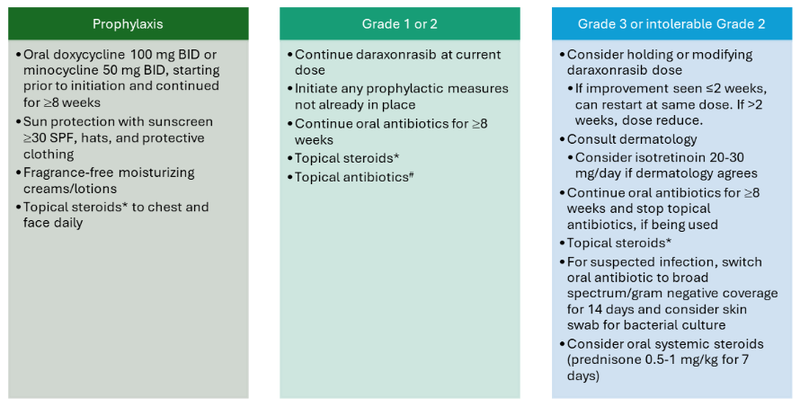
*Topical steroids: triamcinolone acetonide 0.025%, desonide 0.05%, alclometasone 0.05%, fluticasone propionate 0.05%
#Topical antibiotics: erythromycin 1%-2%, metronidazole 1%, clindamycin 1%-2%
Per the prescribing information, providers should consider holding daraxonrasib for Grade 2 rash until resolved to at least Grade 1 or lower. Upon restarting, daraxonrasib may be started at the same or next lower dose level. For patients with Grade 3 rash, daraxonrasib must be held until resolved to at least Grade 1 or lower and then resumed at the next lower dose level. For Grade 4 rash, daraxonrasib should be discontinued.14
Mucositis was also a common issue experienced among patients taking daraxonrasib. Normal oral mucosal epithelium depends on wild-type RAS-MAPK signaling for proliferation, differentiation, and survival. The oral mucosa is among the tissues in the body with the most rapid turnover (~7-14 day renewal cycle), making it exquisitely sensitive to disruption of growth factor signaling. By inhibiting wild-type RAS in these cells, daraxonrasib impairs the RAS-RAF-MEK-ERK cascade, leading to epithelial thinning, loss of barrier integrity, and ulceration.15 The stomatitis associated with daraxonrasib presents as aphthous-like ulcers (preferred terms include stomatitis, mucosal inflammation, aphthous ulcer, and mucosal ulceration) and the recommended prophylaxis and management per the clinical trials is outlined in Figure 2.2,7 The prescribing information does not have any specific recommendations for prophylaxis, but supports initiating chlorhexidine mouthwash or 2% lidocaine viscous solution for treatment.14
Figure 2. Summary from daraxonrasib trials for mucositis prophylaxis and management2
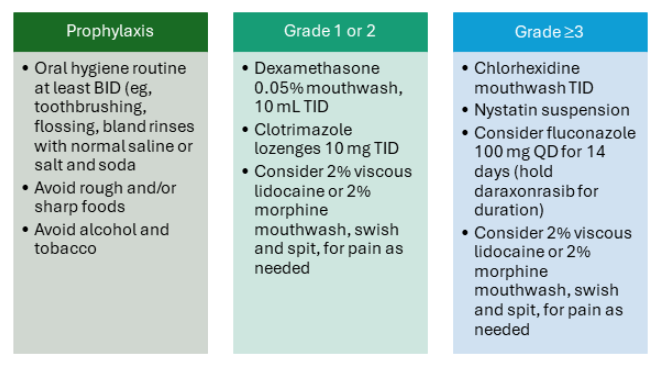
Similar to the recommendations for rash, the prescribing information recommends to consider holding for Grade 2 stomatitis until at least Grade 1, then resuming at the same or lower dose. For Grade 3, daraxonrasib should be held until at least Grade 1 or lower then resumed at the next lower dose. And for Grade 4 stomatitis, patients should permanently discontinue.14
For control of nausea and vomiting, as well as diarrhea, standard supportive care measures can be implemented for patients. If patients have issues with nausea and/or vomiting, antiemetics can be scheduled prior to daraxonrasib doses.7 All of these toxicities are relatively familiar to oncology pharmacists, creating an impactful opportunity for integration into counseling and patient monitoring. Given the frequency of dose interruptions and reductions observed in RASolute 302, early recognition and management of adverse effects are critical in maintaining treatment adherence and dose intensity. The starting dose is 300 mg once daily (available as 150 mg and 100 mg tablets). In cases where patients may not be able to tolerate full doses, dose modifications are as follows: 300 mg once daily -> 200 mg once daily -> 150 mg once daily -> discontinue.14 When the oncologist is discussing potential treatment with daraxonrasib with a patient, it is prime time for pharmacist education and counseling. Emphasis should be placed on ensuring prophylactic measures are initiated prior to starting therapy, early signs of toxicities to report to the treatment team, and how to apply and/or take supportive care interventions once prescribed. Close monitoring and follow up is also a role that oncology pharmacists can assume to ensure patients are compliant and supported.
In addition to supportive care interventions and dose modifications, other aspects of any new medication an oncology pharmacist should be familiar with are the pharmacokinetics and potential drug interactions. The mean terminal half-life daraxonrasib is 9.2 (±2.7) hours and there are no clinically significant food effects.14 In terms of notable drug-drug interactions, data show cytochrome P450 (CYP) 3A4 is the primary CYP isoform responsible for daraxonrasib metabolism.2,16 Daraxonrasib is also a substrate of P-gp. It is therefore recommended to: avoid strong CYP3A4 inhibitors with P-gp inhibition as well as systemic cyclosporine A products; reduce the dose of daraxonrasib with strong CYP3A4 inhibitors without P-gp inhibition, with moderate CYP3A4 inhibitors with or without P-gp inhibition, as well as with P-gp inhibitors; increase the dose of daraxonrasib (to 400 mg) with strong CYP3A4 inducers; separate administration by 4 hours with other P-gp substrates.14 In further pharmacokinetic studies, daraxonrasib appears to have reduced brain penetration, thus potentially limiting its potential as an agent for brain metastases.16 This may not be a worrisome barrier for PDAC patients, as <1% develop brain and/or CNS metastases, but should be a consideration as daraxonrasib moves into treatment spaces for other diseases.17 Pharmacists are uniquely positioned to optimize outcomes for patients receiving daraxonrasib by providing patient education, implementing toxicity prevention and management strategies, identifying potential drug interactions, supporting adherence, and facilitating multidisciplinary care.
Summary
Based on the outstanding evidence seen with daraxonrasib in metastatic PDAC patients, the manufacturer was approved to provide daraxonrasib through an expanded access program in May 2026 to patients with previously treated metastatic PDAC.18,19 Then on August 26, 2026, it received accelerated FDA approval for treatment of metastatic pancreatic adenocarcinoma patients who have received at least one prior systemic therapy or who are not candidates for multiagent systemic therapy.20 But daraxonrasib does not stop there. There are also active trials investigating daraxonrasib in combination with elironrasib (a KRAS G12C inhibitor) in advanced KRAS G12C-mutated solid tumors, in patients with RAS-mutated non-small cell lung cancer (RASolve 301), in the adjuvant setting in patients with resected PDAC (RASolute 304), and in the first-line setting in combination with gemcitabine and nab-paclitaxel (RASolute 303).21-24 This expansion into other disease states as well as earlier lines of treatment for PDAC shows this is only the beginning of the journey for daraxonrasib.
Daraxonrasib represents a transformative advance for patients with metastatic PDAC. The findings from RMC-6236-001 and RASolute 302 have generated considerable excitement within the oncology community and positions daraxonrasib as a promising new treatment option for a patient population with historically poor outcomes and limited therapeutic advances. While the efficacy results are impressive, successful incorporation of daraxonrasib into clinical practice will require proactive management of treatment-related toxicities. Given the frequency of adverse effects and dose modifications in the clinical trials of daraxonrasib, oncology pharmacists will play a critical role in implementing preventive strategies, educating patients, and coordinating supportive care interventions to maintain treatment adherence and quality of life. As the expedited approval journey shows, daraxonrasib stands as a testament to decades of scientific persistence, demonstrating that even the most elusive oncogenic drivers can eventually be brought within therapeutic reach. After decades as oncology's ultimate RAScal, RAS may finally have met its match.
References
-
SEER Stat Fact Sheets. Pancreatic Cancer. National Cancer Institute, Bethesda, MD. Accessed June 3, 2026. Available from: https://seer.cancer.gov/statfacts/html/pancreas.html
-
Wolpin BM, Park W, Garrido-Laguna I, et al. Daraxonrasib in Previously Treated Advanced RAS-Mutated Pancreatic Cancer. N Eng J Med. May 7 2026;394(18):1790–1802.
-
Miller-Phillips L, Collisson EA. RAS and Other Molecular Targets in Pancreatic Cancer: The Next Wave Is Coming. Curr Treat Options Oncol. 2023;24(8):1088–1101.
-
Almoguera C, Shibata D, Forrester K, Martin J, Arnheim N, Perucho M. Most Human Carcinomas of the Exocrine Pancreas Contain Mutant c-K-ras Genes. Cell. 1988;53(May 20):549–54.
-
Der CJ, Yeh JJ. Advances in RAS Therapeutics for Pancreatic Cancer. N Eng J Med. 2026;394(18):1857–61.
-
Cregg J, Edwards AV, Chang S, et al. Discovery of Daraxonrasib (RMC-6236), a Potent and Orally Bioavailable RAS(ON) Multi-selective, Noncovalent Tri-complex Inhibitor for the Treatment of Patients with Multiple RAS-Addicted Cancers. J Med Chem. 2025;68(6):6064–6083.
-
O'Reilly EM, Wainberg ZA, Hendifar AE, et al. Daraxonrasib or Chemotherapy in Previously Treated Metastatic Pancreatic Cancer. N Eng J Med. May 31 2026;doi:10.1056/NEJMoa2605555
-
Cannon M, Castro A. New Cancer Pill Given Standing Ovation at Oncology Conference. Newsweek. Updated 6/3/2026. Accessed June 3, 2026. https://www.newsweek.com/new-cancer-pill-what-is-daraxonrasib-standing-ovation-biggest-oncology-conference-12021009
-
Wang-Gillam A, Li C-P, Bodoky Gr, et al. Nanoliposomal irinotecan with fluorouracil and folinic acid in metastatic pancreatic cancer after previous gemcitabine-based therapy (NAPOLI-1): a global, randomised, open-label, phase 3 trial. Lancet. 2016;387:545–57.
-
Gill S, Ko Y-J, Cripps C, et al. PANCREOX: A Randomized Phase III Study of Fluorouracil/Leucovorin With or Without Oxaliplatin for Second-Line Advanced Pancreatic Cancer in Patients Who Have Received Gemcitabine-Based Chemotherapy. J Clin Oncol. 2016;34(32):3914–3920.
-
Fouchardière CDL, Malka D, Cropet C, et al. Gemcitabine and Paclitaxel Versus Gemcitabine Alone After 5-Fluorouracil, Oxaliplatin, and Irinotecan in Metastatic Pancreatic Adenocarcinoma: A Randomized Phase III PRODIGE 65-UCGI 36-GEMPAX UNICANCER Study. J Clin Oncol. 2024;42(9):1055–1066.
-
Lacouture M, Mitchell E, Piperdi B, et al. Skin toxicity evaluation protocol with panitumumab (STEPP), a phase II, open-label, randomized trial evaluating the impact of a pre-Emptive Skin treatment regimen on skin toxicities and quality of life in patients with metastatic colorectal cancer. J Clin Oncol. 2010;28(8):1351–7.
-
Lacouture ME, Anadkat MJ, Bensadoun RJ, et al. Clinical practice guidelines for the prevention and treatment of EGFR inhibitor-associated dermatologic toxicities. Support Care Cancer. Aug 2011;19(8):1079–95.
-
Rasonque (daraxonrasib) tablets. Prescribing Information. Revolution Medicines, Inc. Revised 8/2026.
-
Li J, Wu W, Chen J, et al. Development and safety of investigational and approved drugs targeting the RAS function regulation in RAS mutant cancers. Toxicol Sci. 2024;202(2):167–178.
-
Schinkel A, Arguedas D, Bui V, et al. Daraxonrasib (RMC-6236) pharmacokinetics: impact of transporters and drug-metabolizing enzymes on a first-in-class pan-RAS molecular glue. Pharmcol Res. 2026:108226.
-
Jacobs E, Patil S, Mittal VK, Jacobs MJ. Incidence and Outcomes of Metastatic Patterns of Pancreatic Ductal Adenocarcinoma. Am Surg. Apr 2026;92(4):1220–1224.
-
FDA Permits Expanded Access for Investigational Pancreatic Cancer Drug. Updated May 1, 2026. Accessed June 4, 2026. https://www.fda.gov/news-events/press-announcements/fda-permits-expanded-access-investigational-pancreatic-cancer-drug
-
NCT07573215: Expanded Access Program for Daraxonrasib (RMC-6236) in Previously Treated Metastatic Pancreatic Adenocarcinoma. Updated May 7, 2026. Accessed June 4, 2026. https://clinicaltrials.gov/study/NCT07573215
-
FDA approves daraxonrasib for metastatic pancreatic adenocarcinoma. Updated 8/26/26. Accessed September 1, 2026. https://www.fda.gov/drugs/resources-information-approved-drugs/fda-approves-daraxonrasib-metastatic-pancreatic-adenocarcinoma
-
NCT06128551: Study of Elironrasib and Daraxonrasib as Monotherapies and Combination Therapy in Participants With Advanced KRAS G12C Mutant Solid Tumors. Updated April 23, 2026. Accessed June 4, 2026. https://clinicaltrials.gov/study/NCT06128551
-
NCT06881784: Study of Daraxonrasib (RMC-6236) in Patients With RAS Mutated NSCLC (RASolve 301) (RASolve 301). Updated May 29, 2026. Accessed June 4, 2026. https://clinicaltrials.gov/study/NCT06881784
-
NCT07252232: Study of Daraxonrasib (RMC-6236) in Patients With Resected Pancreatic Ductal Adenocarcinoma (PDAC) (RASolute 304). Updated June 4, 2026. Accessed June 4, 2026. https://clinicaltrials.gov/study/NCT07252232
-
NCT07491445: Study of Daraxonrasib and Daraxonrasib + GnP as First-line Treatment in Patients With Metastatic Pancreatic Adenocarcinoma (RASolute 303). Updated June 3, 2026. Accessed June 4, 2026. https://clinicaltrials.gov/study/NCT07491445