Summary
Cancer drug repositories (CDRs) are a state-legislated option for healthcare clinicians to respond to the juxtaposition of cancer financial toxicity and corresponding cancer medication waste. CDRs allow for the collection of unused, non-expired cancer medications to be used for patients in need.1-3 Despite their legality, many states have not been able to effectively develop programming to make CDRs available to all residents. In Transforming Cancer Drug Access: Insights into Utilization and Clinician Satisfaction in a Statewide Cancer Drug Repository Network, Mackler and Norman describe the development, utilization, and clinician satisfaction associated with the YesRx Network, a statewide, clinic-facing CDR service organization in Michigan designed to improve access to high-cost cancer therapies and eliminate oral anticancer medication waste. Many newer oral anticancer medications cost tens of thousands of dollars per month, while billions of dollars’ worth of cancer medications go to waste because of dose changes, intolerance, disease progression, therapy discontinuation, or death. The ability to repurpose these medications for those who have medication access barriers has the potential for positive economic and environmental impacts.
The authors of the study sought to evaluate outcomes from the first 24 months of the YesRx Network, including medication donation and dispensing metrics, geographic reach, patient access, clinician experience, and participant satisfaction. Outcomes were assessed via a retrospective analysis of the statewide CDR data collected from the YesRx Network partner sites between, August 2023 to July 2025. Clinician satisfaction was assessed via a 14-item questionnaire delivered across the Network in May 2025.
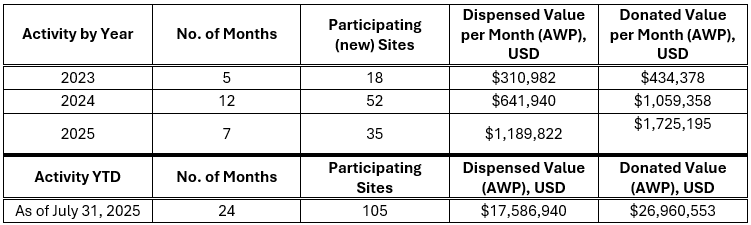
Over 24 months, 1,520 individuals donated over 100,000 viable pills to the CDR and 1,124 patients with cancer received, on average, a 1-month supply of medication at no cost. The growth of the CDR Network’s reach and utilization is shown in Table 1. By the completion of 24 months, 90% of Michigan counties received CDR resources (counted if they had a resident in the county who donated medication to the CDR, received a prescription from the CDR, or both), and nearly $27,000,000 worth of medications were repurposed to those in need. Just over 40% of the patients receiving CDR medication lived in a rural zip code. Breast cancer (28%) was the most common diagnosis CDR recipients, followed by leukemia (18%), lung cancer (12%), prostate cancer (9%), and other cancers accounting for the remaining 33%. CDR recipients spanned across different ages with 5% younger than 40 years, 40% being 40-64 years and 55% over 64 years.
Of the 44 healthcare clinicians that responded to the survey, most respondents agreed that they would not have been able to provide CDR programming if not for YesRx (84% agreed or strongly agreed). More than half the respondents indicated a decrease or no change in workload from participation (67%), and the majority (86%) reported an increase in work satisfaction.
The study demonstrated that a clinic-facing, centrally supported, statewide CDR can dramatically increase access to high-cost cancer medications for patients in need, reduce medication waste, and facilitate equitable access across diverse care settings. By removing much of the administrative burden and protecting clinician agency, YesRx offers a blueprint for how CDRs can be successfully integrated into oncology practices for maximal patient, provider, community, and environmental benefit.1
Table 1. YesRx Network Growth1
Impact for Oncology Pharmacists
The first registered CDR in Michigan was started by a clinic-embedded oncology clinical pharmacist who provided day-to-day education and management for patients receiving oral anticancer agents in a small community-based practice.4 It became clear after two additional sites established programs that there was a need for a shared inventory and for practices and patients in the State to have the ability to access CDR programming that were not part of these first 3 sites.4,5 The YesRx Network was formed based on these tenets and with oncology pharmacists spearheading these grassroots efforts. CDRs offer an incredible opportunity to offset some of the financial toxicity patients with cancer face. They also could inadvertently perpetuate disparities in cancer medication access as site-based programs are more likely to exist in practices/institutions with greater resources, whereas practices with minimal resources or patients living in areas with geographic healthcare access barriers may not have the means to participate.6 Coming together as a State with a shared mission to mitigate disparities in access has helped to circumvent some of this risk.
Oncology pharmacists have a tremendous opportunity to improve cancer medication access and reduce waste by being familiar with their state legislation, advocating for patient access to CDR programming, raising awareness, and providing the needed education for successful CDR implementation.
References
-
Mackler ER, Norman S. Transforming Cancer Drug Access: Insights into Utilization and Clinician Satisfaction in a Statewide Cancer Drug Repository Network. JCO Oncol Pract. 2025;21(12):1860-1866.
-
American Society of Clinical Oncology: Position Statement on Drug Repository Programs. 2022. https://cdn.bfldr.com/KOIHB2Q3/as/c5sccm86fvg48sb7wbc859/2022-Drug-Repository-Statement
-
Heater NK, Kircher S, Weldon C, et al. Oncologic drug repository programs in the United States: A review and comparison. Health Aff Sch 2:qxae031, 2024.
-
Sias K, Cloud A, Melgarejo K, et al. Influence of a community practice innovation on a statewide cancer drug repository network. JCO Oncol Pract. 20, 2024 (suppl 10; abstr 115)
-
McKendry M, Mackler E, Melgarejo K, et al: Incorporation of a Statewide Cancer Drug Repository Program within an integrated specialty pharmacy. 2025 annual HOPA meeting. J Hematol Oncol Pharm 15:Abstract #LB03, 2025
-
Kale S, Hirani S, Vardhan S, et al. Addressing Cancer Disparities through Community Engagement: Lessons and Best Practices. Cureus. 2023;15(8):e43445.