Introduction and Evolving Treatment Paradigm
Immune thrombocytopenia (ITP) has undergone a significant conceptual transformation over the past several decades. Historically, ITP was defined as an autoimmune disorder characterized primarily by antibody-mediated platelet destruction, leading to isolated thrombocytopenia. Therefore, early therapeutic strategies sought to suppress antibody production or remove the primary site of platelet sequestration and clearance. However, ITP is now better understood as a heterogeneous syndrome of immune dysregulation, involving complex interactions between humoral immunity, cellular immune responses, and impaired megakaryocyte function leading to reduced platelet production.1,2,3 These insights have fundamentally reshaped the pathophysiological model of the disease and have driven the development of targeted therapeutic strategies that address multiple underlying mechanisms rather than platelet destruction alone.
The 2019 American Society of Hematology (ASH) guidelines reflected this evolving understanding while maintaining a pragmatic, algorithm-based approach to treatment.4 First-line therapy continues to consist primarily of corticosteroids, administered with or without intravenous immunoglobulin (IVIG) when a rapid increase in platelets is required, with the intent of preventing clinically meaningful bleeding.4 While the guidelines for emergent management of ITP with critical bleeding recommend a more aggressive approach including a combination of high-dose corticosteroids, IVIG, platelet transfusions, tranexamic acid, and thrombopoietin receptor agonists (TPO-RAs).5
If initial treatment fails, the ASH guidelines move away from sequencing and towards recommending several therapeutic options with relative parity – rituximab, thrombopoietin receptor agonists (TPO-RAs), and splenectomy – with ultimate selection individualized based on bleeding risk, patient comorbidities and preferences, and disease characteristics.4,6 TPO-RAs, including eltrombopag, romiplostim, and avatrombopag, exhibit platelet response rates around 60-90%, with the median time to response being approximately 1-2 weeks. However, these agents function by stimulating thrombopoiesis to overcome immune destruction without addressing underlying immune dysregulation. Consequently, long-term therapy is often required, and sustained remission following discontinuation is achieved in fewer than 30% of patients.6,7
More recently, the therapeutic landscape has expanded to include targeted immunomodulatory agents including the spleen tyrosine kinase (SYK) inhibitor, fostamatinib, and Bruton’s tyrosine kinase (BTK) inhibitor, rilzabrutinib.8,9 These advances, alongside emerging therapeutic modalities, underscore a paradigm shift toward precision immunomodulation guided by disease biology.
Immunopathophysiology of ITP
The pathogenesis of ITP is multifactorial and involves dysregulation across several immune compartments. Central to disease pathology is the interplay between autoantibody production, Fc receptor-mediated platelet clearance, T-cell dysfunction, and impaired platelet production.3,10,11
- Humoral Autoimmunity and Fc-Mediated Clearance
Autoantibodies, primarily IgG, target platelet surface glycoproteins GPIIb/IIIa and GPIb/IX. These antibodies opsonize circulating platelets, facilitating their clearance via Fcϒ receptor-mediated phagocytosis by macrophages, particularly within the spleen.1,12 Furthermore, autoantibodies can activate the formation of the complement cascade on platelet surfaces, resulting in lysis.10 The Fc-dependent pathway represents the critical effector phase of platelet destruction and is central to multiple therapeutic strategies.
2. Cellular Immune Dysregulation
T-cell-mediated mechanisms contribute significantly to disease pathogenesis, including:
- Increased cytotoxic CD8+ T-cell activity targeting platelets and megakaryocytes
- Skewing toward pro-inflammatory T-helper 1 and 17 phenotypes
- Reduced regulatory T-cell populations, leading to loss of immune tolerance
These abnormalities result in sustained immune activation and persistence of autoimmune responses.3,13
3. Impaired Platelet Production
In addition to increased destruction, impaired thrombopoiesis contributes to thrombocytopenia. Autoantibodies and cytotoxic T-cells disrupt megakaryocyte maturation and function, leading to insufficient platelet production.2,10
4. Therapeutic Implications
This integrated model explains why therapies targeting a single pathway often produce incomplete responses and why combination or multimodal strategies may be required to prevent treatment resistance through disease evolution.3,10 Importantly, it provides the rationale for therapies that target convergent signaling pathways, such as SYK and BTK.3
Historical Therapeutic Approaches and Fc Pathway Targeting
Splenectomy represents a prototypical intervention targeting Fc-mediated clearance. By removing the primary site of macrophage-mediated platelet destruction and antibody production, splenectomy produces durable remissions in approximately 70-80% of patients, with many maintaining remission for years.1,14 However, lifelong infection risk and thrombotic complications have limited its use. IVIG provides rapid but transient platelet increases by saturating Fc receptors on macrophages, thereby reducing platelet clearance. Platelet responses typically occur within 24-48 hours and persist for approximately 2-4 weeks.4,15 Anti-D immune globulin has a similar mechanism, redirecting macrophage activity toward antibody-coated erythrocytes. However, its use has declined due to the risk of hemolysis and the availability of alternative therapies.16
Traditional Immunosuppressive Therapies
Corticosteroids remain the mainstay of initial therapy. Response rates approach 70-80%, though durable remission is achieved in only 20-40% of patients.4 Their broad immunosuppressive effects include inhibition of macrophage function, cytokine suppression, and decreased autoantibody production.
Subsequent immunosuppressive agents’ response rates:
- Azathioprine, mycophenolate mofetil: ~40-60%
- Cyclosporine: ~50-70% through T-cell suppression
- Cyclophosphamide: ~60% in refractory disease
Despite efficacy in some patients, these therapies are limited by non-specific immune suppression, delayed onset, and toxicity.17,18
Among targeted immunomodulatory approaches, rituximab was one of the first therapies to specifically target the humoral immune component of ITP through depletion of CD20-positive B cells.19 Response rates are approximately 50-60% (complete responses 20-30%), but durability is limited and typically occurs within 4 to 8 weeks, consistent with the time required for B-cell depletion and subsequent reduction in autoantibody titers.6,19 However, durability remains a major limitation, with relapse rates as high as 60% within 2 to 5 years of treatment. Many patients ultimately require retreatment or transition to alternative therapies. These clinical outcomes reflect key mechanistic limitations. Rituximab does not target long-lived plasma cells, which may continue producing pathogenic autoantibodies despite B-cell depletion.3,10 In addition, rituximab has minimal direct impact on Fc receptor-mediated platelet clearance, which constitutes the terminal effector phase of disease. 3,10 As a result, patients with disease driven by macrophage activation or T-cell-mediated mechanisms may exhibit diminished or transient responses.
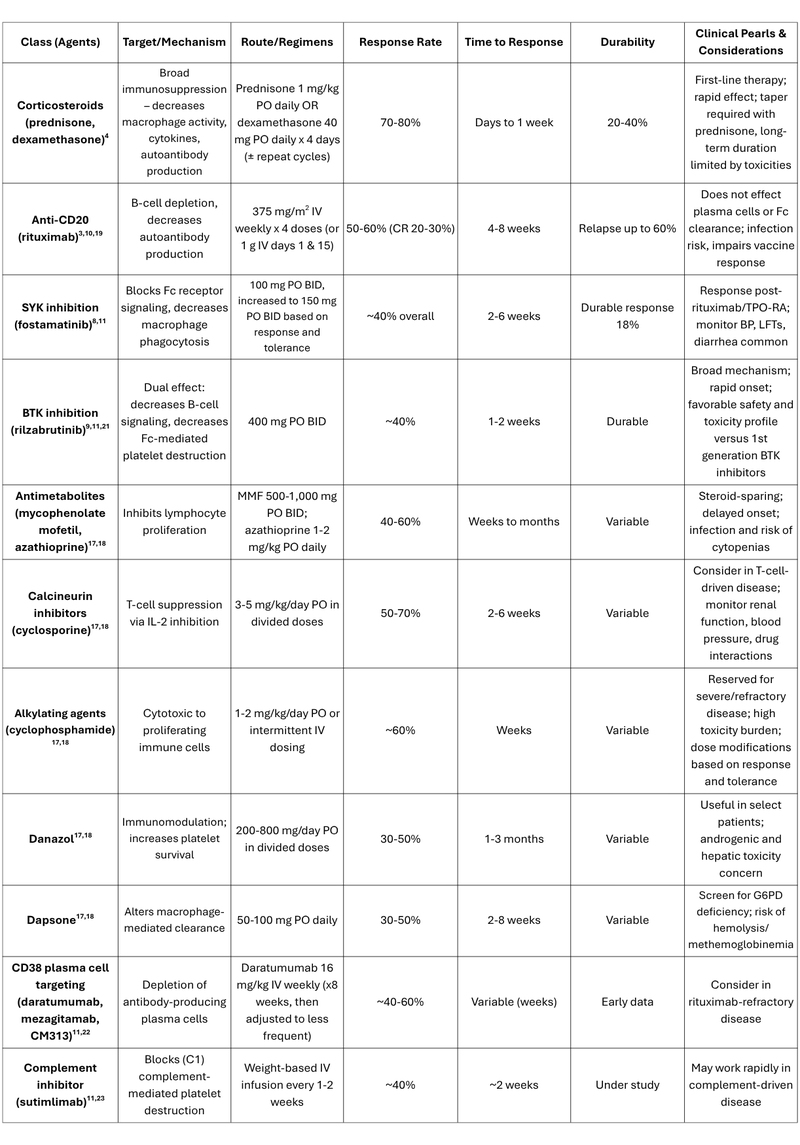
The therapeutic landscape of ITP spans a diverse range of immunosuppressive and immunomodulatory approaches, each targeting distinct components of disease pathophysiology with varying response rates, onset of action, and toxicity profiles. A comparative summary of commonly utilized agents, including their mechanisms, clinical efficacy, and practical considerations, is provided in Table 1.
New Approaches and Therapies for ITP
- SYK Inhibition with Fostamatinib
Fostamatinib represents a mechanistically distinct approach to ITP management by targeting the effector phase of platelet destruction rather than upstream antibody production.8 As an oral inhibitor of spleen tyrosine kinase (SYK), fostamatinib disrupts intracellular signaling downstream of the Fcγ receptor on macrophages, thereby preventing phagocytosis of antibody-opsonized platelets.8,11
The efficacy of fostamatinib was established in two pivotal phase III trials, FIT1 and FIT2, which enrolled patients with persistent or chronic ITP who had received at least one prior therapy.8 The primary endpoint – stable response defined as achieving platelet counts ≥50 ×10⁹/L during the majority of visits from weeks 14-24 – was achieved in approximately 18% of patients receiving fostamatinib, compared with only 2% in the placebo arm.8 Overall response rates, defined more broadly as any platelet count ≥50 ×10⁹/L, approached 40%, with responses often observed within 2 to 6 weeks of treatment initiation. Importantly, fostamatinib demonstrated activity in patients who had previously failed rituximab, TPO-RAs, and splenectomy, supporting its role in refractory disease.8 These findings underscore its mechanistic independence from antibody production and highlight the significance of directly targeting Fc receptor–mediated clearance.
Adverse effects observed in clinical trials included hypertension, diarrhea, and transaminase elevations, generally manageable with dose adjustments or supportive care.8 Compared with traditional immunosuppressants, fostamatinib offers a more targeted approach with a distinct toxicity profile, though its modest durable response rates suggest that additional pathways contribute to disease persistence.
2. BTK Inhibition and Rilzabrutinib
BTK occupies a central role in immune signaling, acting as a critical mediator of both B-cell receptor activation and Fc receptor-mediated macrophage function (Mititelu 2024). BTK inhibition leverages a multimodal mechanism to attenuate B-cell activation and antibody generation, making it an especially attractive therapeutic target in ITP.11
Early evidence supporting BTK inhibition in ITP emerged from studies of first-generation BTK inhibitors, such as ibrutinib, in ITP and other autoimmune conditions, where modulation of B-cell activation and innate immune signaling produced clinically meaningful immunomodulatory effects.20 These observations provided proof-of-concept for dual-pathway targeting and laid the groundwork for the development of more selective agents.
Rilzabrutinib is a next-generation, reversible oral BTK inhibitor designed to provide potent target engagement with improved safety and tolerability.9,21 Unlike covalent BTK inhibitors, rilzabrutinib allows transient inhibition of BTK signaling, potentially reducing off-target effects and preserving immune function.
Rilzabrutinib was evaluated in the phase 3 LUNA 3 trial and demonstrated statistically significant improvements with 23% of responders achieving a durable platelet response rate compared to placebo, defined as maintaining platelet counts ≥50 ×10⁹/L across multiple time points.9 Furthermore, there were no cases of atrial fibrillation, bleeding and infectious complications were rare, and only one patient developed a thromboembolism that the investigators deemed not related to rilzabrutinib.9 These findings confirm the clinical efficacy of BTK inhibition in ITP without the expected toxicity of first-generation BTK inhibitors and support its emerging role in treatment algorithms.
Emerging Immunologic Targets
- Daratumumab – First CD38 Monoclonal Antibody
Emerging therapies aim to address residual disease pathways, particularly persistent autoantibody production, cytokine- and complement-mediated mechanisms.11 Daratumumab, an anti-CD38 monoclonal antibody widely used in multiple myeloma to target plasma cells, has shown activity in refractory ITP, with small case series reporting response rates of 40% to 60%, particularly among patients previously treated with rituximab.22 These findings support the role of plasma cells as a source of ongoing antibody production.
2. Mezagitamab – New Generation of CD38 Monoclonal Antibody
More recently, novel CD38-targeting agents such as CM313 and mezagitamab (TAK-079) have been investigated in early-phase studies.11 These agents can induce rapid and sustained increases in platelet counts, likely through depletion of autoreactive plasma cells and modulation of immune signaling. The drug is not yet FDA-approved.
3. Sutimlimab – Complement Inhibitor
Complement inhibition represents another emerging strategy.11 Sutimlimab, a monoclonal antibody targeting the C1s component of the classical complement pathway, was found in a phase 2 study to produce rapid platelet increases within days in select patients, suggesting that complement-mediated platelet destruction may contribute to disease pathogenesis in a subset of individuals.23 These results further reinforce the heterogeneity of ITP and the need for pathway-specific therapies.
4. Ianalumab – Immune Checkpoint Inhibitor
Ianalumab is a first-in-class anti-B-cell activating factor (BAFF) that is being evaluated in combination with eltrombopag in the phase III VAYHIT2 trial. The dual mechanism if ianalumab enables enhanced B-cell depletion and BAFF receptor block to inhibit B-cell activation, maturation, and survival. Preliminary data resulted in almost double the number of patients achieved a remission after 1 year with eltrombopag plus placebo than with placebo alone. Furthermore, the trial is designed to evaluate a time-limited treatment which could decrease medication burden associated with ITP.24 The drug is not yet FDA-approved.
Immune Profiling and Precision Medicine
Recent advances in immune profiling have provided new insights into the biologic heterogeneity of ITP and the mechanisms underlying differential treatment responses. A recent study uses flow cytometry and RNA sequencing to characterize immune signatures associated with response to rituximab. This study demonstrated that responders exhibited a predominantly B-cell–driven immune profile, whereas non-responders were characterized by T-cell–mediated inflammation, increased clonal expansion, and features of immune exhaustion.25
These findings provide compelling evidence that ITP encompasses multiple immunologic subtypes rather than a single disease entity. Importantly, they suggest that treatment response is closely linked to the dominant immune mechanism driving disease in individual patients. This approach has the potential to transition ITP management toward precision immunotherapy, in which therapies are selected based on underlying disease biology rather than trial-and-error escalation. Such a paradigm would improve response rates, reduce exposure to ineffective therapies, and minimize cumulative immunosuppression.
Conclusion
ITP is best understood as a heterogeneous immune disorder requiring a mechanism-based approach to therapy. Targeted agents such as SYK and BTK inhibitors represent major advances, with BTK inhibition emerging as a particularly promising strategy due to its dual-pathway effects.8,9 Integration of immune profiling may further refine therapy selection toward precision immunotherapy.

Table 1. Immunosuppressive and Immunomodulatory Therapies in Immune Thrombocytopenia
References
-
Ahn YS, Harrington WJ. Treatment of idiopathic thrombocytopenic purpura. Annu Rev Med. 1977;28:299-307.
-
Cines DB, Blanchette VS. Immune thrombocytopenic purpura. N Engl J Med. 2002;346(13):995-1008.
-
Audia S, Mahevas M, Samson M, et al. Pathogenesis of immune thrombocytopenia. Autoimmun Rev. 2017;16(6):620-632.
-
Neunert C, Terrell DR, Arnold DM, et al. American Society of Hematology 2019 guidelines for immune thrombocytopenia. Blood Adv. 2019;3(23):3829-3866.
-
Chowdhury SR, Sirotich E, Guyatt G, et al. Guideline on the Emergency Management of Critical Bleeding in Patients with Immune Thrombocytopenia. Blood Advances. 2026. https://doi.org/10.1182/bloodadvances.2025018818.
-
Rodeghiero F, Michel M, Gernsheimer T, et al. Standardization of bleeding assessment in immune thrombocytopenia: report from the International Working Group. Blood. 2013;121(14):2596-2606.
-
Kuter DJ. The biology of thrombopoietin and thrombopoietin receptor agonists. Int J Hematol. 2013;98(1):10-23.
-
Bussel JB, Arnold DM, Grossbard E, et al. Fostamatinib for the treatment of adult persistent and chronic immune thrombocytopenia: results of two phase 3, randomized, placebo-controlled trials. Am J Hematol. 2018;93(7):921-930.
-
Kuter DJ, Ghanima W, Cooper N, et al. Safety and efficacy of rilzabrutinib vs placebo in adults with immune thrombocytopenia: the phase 3 LUNA3 study. Blood. 2025; 145(24): 2914-2926.
-
McMillan R. The pathogenesis of chronic immune thrombocytopenic purpura. Semin Hematol. 2007;44(4 Suppl 5):S3-S11.
-
Mititelu A, Onisai MC, Rosca A, et al. Current Understanding of Immune Thrombocytopenia: A Review of Pathogenesis and Treatment Options. Int J Mol Sci. 2024; 25(4): 2163.
-
Shulman NR, Marder VJ, Weinrach RS. Similarities between known antiplatelet antibodies and the factor responsible for thrombocytopenia in idiopathic purpura. Ann N Y Acad Sci. 1965;124:499-542.
-
Semple JW, Provan D. The immunopathogenesis of immune thrombocytopenia: T cells still take center-stage. Curr Opin Hematol. 2012;19(5):357-362.
-
Kumar S, Diehn FE, Gertz MA, Tefferi A. Splenectomy for immune thrombocytopenic purpura: long-term results and treatment trends. Ann Hematol. 2002;81(6):312-319.
-
Bussel JB, Kuter DJ, Pullarkat V, et al. Safety and efficacy of long-term treatment with romiplostim in thrombocytopenic patients with chronic ITP. Blood. 2009;113(10):2161-2171.
-
George JN, El-Harake MA, Raskob GE. Chronic idiopathic thrombocytopenic purpura. N Engl J Med. 1994;331(18):1207-1211.
-
Provan D, Stasi R, Newland AC, et al. International consensus report on the investigation and management of primary immune thrombocytopenia. Blood. 2010;115(2):168-186.
-
Stasi R, Evangelista ML, Stipa E, et al. Idiopathic thrombocytopenic purpura: current concepts in pathophysiology and management. Thromb Haemost. 2008;99(1):4-13.
-
Arnold DM, Dentali F, Crowther MA, et al. Systematic review: efficacy and safety of rituximab for adults with idiopathic thrombocytopenic purpura. Ann Intern Med. 2007;146(1):25-33.
-
Labanca C, Martino EA, Vigna E, et al. Rizabrutinib for the Treatment of Immune Thrombocytopenia. Eur J Haematol. 2025; 115(1):4-15.
-
Kuter DJ, Arnold DM, Cooper N, et al. Rilzabrutinib, an oral BTK inhibitor, in immune thrombocytopenia. N Engl J Med. 2022;386(15):1421-1431.
-
Crickx E, Audia S, Robbins A, et al. Daratumumab, an original approach for treating multi-refractory autoimmune cytopenia. Haematologica. 2021;106(12):3198-3201.
-
Röth A, Barcellini W, D’Sa S, et al. Sutimlimab in cold agglutinin disease and complement-mediated hemolysis. N Engl J Med. 2021;384(14):1323-1334.
-
Al-Samkari H, Cuker A, Zaja F et al. Primary results from VAYHIT, a randomized, double-blind, phase 3 trial of ianalumab plus eltrombopag versus placebo plus eltrombopag in patients with primary immune thrombocytopenia (ITP) who failed first-line corticosteroid treatment. Blood. 2025;146(suppl 2):LBA-2
-
Au A, Tran MMH, Khera A, et al. Pre-treatment immune profiling by flow cytometry and single-cell transciptomics identifies distinct features in B and T cells in rituximab responders and non-responders. Presented at: American Society of Hematology Annual Meeting; 2025.