Allogeneic hematopoietic stem cell transplantation (allo-HSCT) remains a potentially curative therapy for high-risk hematologic malignancies, including acute myeloid leukemia (AML), acute lymphoblastic leukemia (ALL), mixed phenotype acute leukemia (MPAL), and myelodysplastic syndrome (MDS). Unfortunately, transplant-related complications, including acute and chronic graft-versus-host disease (GVHD), infections, organ toxicity, and disease relapse, continue to limit outcomes. Multiple factors, including donor type, HLA matching, graft source, conditioning intensity, recipient comorbidities, disease status, and GVHD prophylaxis strategy, affect patient outcomes. One area that has continued to evolve is GVHD prophylaxis strategies, as the balance between relapse and GVHD remains an active area of clinical research.1-4
Historically, prophylaxis with tacrolimus plus methotrexate (Tac/MTX) was commonly used as a standard approach in matched donor allo-HSCT. In a randomized phase 3 study, Tac/MTX reduced grade II-IV acute GVHD compared with cyclosporine/methotrexate, supporting its widespread adoption in clinical practice.1 Despite years of optimization, Tac/MTX based GVHD prophylaxis for myeloablative conditioning regimen is associated with acute GVHD rates upwards of 30% and chronic GVHD rates upwards of 37%.2-3 Due to the limitations of Tac/MTX, more trials began to optimize GVHD prophylaxis strategies. Recently, post-transplant cyclophosphamide (PTCy) has reshaped modern GVHD prevention. In the phase 3 BMT CTN 1703 trial, PTCy with tacrolimus and mycophenolate mofetil improved GVHD-free, relapse-free survival (GRFS) compared with Tac/MTX in patients receiving reduced-intensity conditioning (RIC) peripheral blood stem cell transplantation from matched-related, matched-unrelated, or 7/8 mismatched-unrelated donors.4 This data has accelerated the usage of PTCy-based approaches across many medical centers.
Although PTCy prophylaxis is an advanced practice, further studies with PTCy, including different conditioning intensities and donor types, are need. One area under active investigation is the role of PTCy in MAC regimens. The BMT 1301 trial demonstrated a two-year Kaplan-Meier estimate for chronic GVHD or relapse-free survival (CRFS) to be 50.6% (95% CIs, 40.8 to 59.6), 48.1% (95% CI, 38.5 to 57.1), and 41.0% (95% CI, 32 to 49.9) for CD34+ selected cells, PTCy, and Tac and MTX, respectively.6 Currently, additional phase 3 trials are lacking to demonstrate the utility of PTCy in MAC regimens, largely due to the concern for toxicity. Despite these advances, questions still remain regarding optimal prophylaxis across conditioning intensity, donor type, relapse risk, immune reconstitution, infection risk, and transplant logistics.
Orca-T provides a novel approach to allogeneic hematopoietic stem cell transplantation. Rather than relying primarily on post-transplant pharmacologic immunosuppression, designed to deplete donor T lymphocytes to prevent GVHD, Orca-T uses a precision-engineered donor graft composed of purified hematopoietic stem and progenitor cells (HSPCs), regulatory T cells (Tregs), and conventional T cells (Tcons). The goal is to reduce GVHD and infections through graft modulation while preserving immune recovery, graft-versus-leukemia (GVL) activity, reducing non-relapse mortality (NRM), and overall transplant efficacy.5 Orca-T is designed to regulate donor T-cell activity, supporting immune system recovery while reducing the risk of graft-versus-host disease (GVHD).
PRECISION-T TRIAL
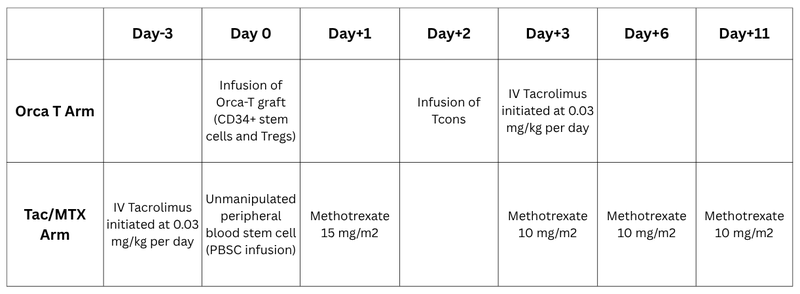
PRECISION-T was a multicenter, randomized phase 3 trial comparing Orca-T plus single-agent tacrolimus with Tac/MTX in adults undergoing myeloablative conditioning for AML in remission, ALL, MPAL, or MDS with <10% circulating blasts, conducted at 19 centers in USA.5 A total of 187 patients were randomized, with 93 assigned to Orca-T and 94 assigned to conventional allo-HSCT. Eligible patients were adults undergoing the first myeloablative allo-HSCT from HLA-matched related or unrelated donors with a hematopoietic cell transplantation-specific comorbidity index (HCT-CI) of ≤4. Patients received myeloablative conditioning before transplant with either fludarabine/thiotepa/busulfan, etoposide/total body irradiation (TBI), or cyclophosphamide/TBI. In the control arm, patients received a conventional G-CSF-mobilized peripheral blood stem cell graft with tacrolimus and methotrexate prophylaxis. In the Orca-T arm, patients received an engineered graft containing purified donor hematopoietic stem and progenitor cells and Tregs on day +0, followed by Tcons on day +2 or +3, with tacrolimus starting on the day after Tcon infusion as the sole pharmacologic GVHD prophylaxis. Tacrolimus was initiated at 0.03 mg/kg per day via IV, with a goal trough of 5-10 ng/mL in both arms. Tapering of tacrolimus was initiated on or after 90 days after HSCT in the absence of active GVHD. This taper consisted of a 20% reduction per month. In the Tac/MTX arm, Methotrexate was administered as an IV bolus at doses of 15 mg/m2 on day +1 and 10 mg/m2 on days +3, +6, and +11. Additionally, post-transplant maintenance with FMS-like tyrosine kinase 3 (FLT3), isocitrate dehydrogenase (IDH), or breakpoint cluster region-Abelson murine leukemia viral oncogene homolog 1 (BCR-ABL) inhibitors was allowed on study.
Table 1: GVHD Prevention Strategies
The primary endpoint was survival free from moderate-to-severe chronic GVHD (cGFS). The median follow-up was 11.4 months (range, 0.2-24.3). Patients enrolled in this study were primarily white (74.3%) and aged 18 to 55 (73.3%). Orca-T significantly improved cGFS compared with Tac/MTX. cGVHD occurred in 14 patients in the Orca-T arm and 44 in the Tac/MTX arm with a hazards ratio of 0.26 (95% CI, 0.14–0.47; P < .001). At 1 year, cGFS was 78.0% with Orca-T compared with 38.4% with Tac/MTX.5 Rates of moderate-to-severe chronic GVHD were also substantially lower with Orca-T (12.6% vs 44.0%; P<0.001). GVHD-free, relapse-free survival was higher with Orca-T (63.1% vs 30.9%; P<0.001), and non-relapse mortality (NRM) was lower (3.4% vs 13.2%; P=0.03). One-year overall survival was numerically higher with Orca-T (93.9% vs 83.1%), although this difference did not reach statistical significance (P=0.12).5 Furthermore, relapse-free survival (RFS) appeared similar between groups at 1 year (75.5% with Orca-T vs 74.1% with Tac/MTX). The cumulative incidence of relapse or progression was higher with Orca-T (21.1% vs 12.7%) but failed to reach statistical significance (P = 0.33).5 Additionally, safety outcomes favored Orca-T; grade 3-4 acute GVHD by day 180 were lower with Orca-T (6.2% vs 16.5% HR, 0.37; 95% CI, 0.13-1.02; P = 0.044). The additional safety items, including chronic GVHD, infections, and rehospitalizations after initial discharge, were also less frequent in the Orca-T arm. Grade 3 infections were reduced, with a 1-year incidence of 8.4% with Orca-T compared with 16.1% with Tac/MTX.5 Rehospitalizations were reduced with a 1-year incidence of 27.3% with Orca-T compared to 45.7% with Tac/MTX.5 Ultimately, ORCA-T demonstrates less acute and chronic GVHD and a favorable safety profile without a statistically significant difference in RFS or OS.
Place in Therapy
PRECISION-T demonstrated a marked reduction in moderate-to-severe chronic GVHD with Orca-T compared with Tac/MTX in patients undergoing matched donor myeloablative allo-HSCT. The benefit was clinically meaningful, with almost doubling of 1-year cGFS and a noticeable reduction in moderate-to-severe chronic GVHD, emphasizing the role of T- reg-based immunotherapy in GVHD prophylaxis. Additionally, as of June 30, 2026, the Food and Drug Administration (FDA) approved allogeneic regulatory T-cell based immunotherapy with hematopoietic stem and progenitor cells and T-cells-vldq for use in matched donor HSCT with myeloablative condition for hematopoietic and immunologic reconstitution and to improve cGHVD-free survival, in the treatment of adults with hematological malignancies.
There were many great takeaways from this study, including reductions in NRM, serious infections, grade 3-4 acute GVHD, and rehospitalization. One of the biggest takeaways from this study is the primary outcome, reduction in moderate-to-severe chronic GVHD. Chronic GVHD is associated with increased NRM, prolonged immunosuppression, infectious complications, impaired functional status, and diminished quality of life. Therefore, the substantial reduction in chronic GVHD observed with Orca-T has the potential to translate into meaningful long-term benefits. While grade 3-4 acute GVHD was reduced, there was no statistically significant difference in grade 2 GVHD, while grade 1 GVHD was not reported but is expected to be common in both arms.
One of the key clinical questions is whether GVHD reduction compromises relapse control. In PRECISION-T, relapse-free survival at 1 year was similar between Orca-T and the control arm, suggesting that GVL activity was preserved despite a lower rate of acute GVHD at day 180. Considering that the day 180 acute GVHD was lower in the Orca-T arm, this is significant. However, the higher cumulative incidence of relapse or progression with Orca-T should be interpreted cautiously until there is further long-term data, ideally at longer time points such as 1, 3, and 5 years. It will be important to confirm the durability of disease control and better define whether GVHD reduction can be achieved without sacrificing long-term relapse protection.
Although the data are impressive, it is important to highlight some of the key limitations. The first limitation is the comparator arm chosen, Tac/MTX. Tac/MTX remains a relevant historical and clinical comparator, but PTCy-based prophylaxis has become increasingly adopted after BMT CTN 1703.4 PRECISION-T does not answer whether Orca-T is superior to PTCy-based prophylaxis, particularly because BMT CTN 1703 studied a different population and used RIC rather than myeloablative conditioning. Currently, the role of PTCy in MAC regimens is lacking data. BMT CTN 1703 only enrolled patients receiving nonmyeloablative (NMA) conditioning or reduced-intensity conditioning (RIC). Future trials comparing PTCy and Orca-T with MAC regimens would help determine superiority.
External validity is another key limitation at this time. PRECISION-T enrolled patients undergoing myeloablative matched donor transplantation for AML, ALL, MPAL, or MDS. This does not account for patients who may not have a matched donor or patients who cannot tolerate a myeloablative regimen. Many patients undergoing an allo-HSCT are older and have more comorbidities than the population presented in this trial. According to data from the CIBMTR, roughly 37% of patients are older than 65 years old and 56% of patients have a HCT-CI of 3 or higher; whereas the PRECISION enrolled patients up to a HCT-CI of 3.7 Ultimately, the role of Orca-T in older patients, patients receiving reduced-intensity conditioning, haploidentical transplantation, mismatched donors, and patients with high-risk molecular features remain uncertain and will require future studies to determine utility. Although, there is an active ongoings study evaluating this use (NCT07216443). Further studies including patients with TP53 mutations, MRD-positive status, or other ELN-adverse risk categories would be useful, as these patients are often underrepresented in studies.
Operational feasibility also plays a critical role when discussing Orca-T as a standard option. Orca-T requires more graft manufacturing and coordination, which may introduce barriers related to both accessibility and cost. Of note, the vein-to-vein time (from donor apheresis to infusion) was within 72 hours with Orca-T. Large medical centers may be able to accommodate, whereas smaller community-based centers may struggle. These implementation issues will determine whether the results of PRECISION-T can be translated into routine practice.
Overall, Orca-T demonstrates a unique GVHD prophylaxis approach through graft engineering. PRECISION-T supports Orca-T as a potentially less toxic alternative to Tac/MTX for matched donor myeloablative allo-HSCT, with statistically significant reductions in chronic GVHD, NRM, serious infections, and rehospitalization. However, longer follow-up and prospective comparisons against PTCy-based approaches are needed before its role in standard transplant practice is fully defined.
References
-
Ratanatharathorn V, Nash RA, Przepiorka D, et al. Phase III study comparing methotrexate and tacrolimus (FK506) with methotrexate and cyclosporine for graft-versus-host disease prophylaxis after HLA-identical sibling bone marrow transplantation. Blood. 1998;92(7):2303-2314.
-
Uberti JP, Ayash L, Ratanatharathorn V, et al. Tacrolimus and methotrexate for the prophylaxis of acute graft-versus-host disease in allogeneic bone marrow transplantation. Bone Marrow Transplant. 1997;19(12):1233-1238.
-
Freyer CW, Petersen FB, Storer BE, et al. Leucovorin rescue after methotrexate graft-versus-host disease prophylaxis for allogeneic hematopoietic cell transplantation. Transplant Cell Ther. 2021;27(12):1020.e1-1020.e8.
-
Bolaños-Meade J, Hamadani M, Wu J, et al. Post-transplantation cyclophosphamide-based graft-versus-host disease prophylaxis. N Engl J Med. 2023;388(25):2338-2348. doi:10.1056/NEJMoa2215943
-
Meyer E, Salhotra A, Gandhi A, et al. Orca-T versus allogeneic hematopoietic stem cell transplantation (PRECISION-T): a multicenter, randomized phase 3 trial. Blood. 2026;147(11):1168-1177. doi:10.1182/blood.2025031313
-
Luznik L, Pasquini MC, Logan B, et al. Randomized Phase III BMT CTN Trial of Calcineurin Inhibitor-Free Chronic Graft-Versus-Host Disease Interventions in Myeloablative Hematopoietic Cell Transplantation for Hematologic Malignancies. J Clin Oncol. 2022;40(4):356-368. doi:10.1200/JCO.21.02293
-
Spellman SR, Xu K, Oloyede T, Ahn KW, Akhtar O, Bolon YT, Broglie L, Bloomquist J, Bupp C, Chen M, Devine SM, El-Jurdi N, Hamadani M, Hengen M, Huppler AH, Jaglowski S, Kuxhausen M, Lee SJ, Moskop A, Page KM, Pasquini MC, Perez W, Phelan R, Rizzo D, Saber W, Stefanski HE, Steinert P, Tuschl E, Visotcky A, Vogel R, Auletta JJ, Shaw BE, Allbee-Johnson M. Current activity trends and outcomes in hematopoietic cell transplantation and cellular therapy - A report from the CIBMTR. Transplant Cell Ther. 2025 Aug;31(8):505-532. doi:10.1016/j.jtct.2025.05.014. Epub 2025 May 19. PMC12302970.