Authors
- Marshall Winget, PharmD, Clinical Pharmacy Specialist - Adult Malignant Hematology, Duke University Medical Center, Durham, NC
- Bradley Yelvington, PharmD, BCOP, Clinical Pharmacist Specialist - Adult Malignant Hematology, Vanderbilt University Medical Center, Nashville, TN
Food and Drug Administration (FDA) Belantamab Mafodotin-bmlf Approvals
Belantamab mafodotin is a humanized antibody-drug conjugate targeting B-cell maturation antigen (BCMA), directing its anti-microtubule payload (monomethyl auristatin F) toward multiple myeloma cells. On October 23, 2025, the FDA approved belantamab mafodotin-bmlf in combination with bortezomib and dexamethasone for adults with relapsed or refractory multiple myeloma having received >/= 2 prior lines of therapy, of which included a proteasome inhibitor and an immunomodulatory agent.1
Belantamab mafodotin has been under FDA review since it was initially approved in August 2020 for the treatment of adult patients with relapsed/refractory multiple myeloma who have received at least 4 prior therapies, including an anti-CD38 monoclonal antibody, a proteasome inhibitor, and an immunomodulatory agent.2 Accelerated approval was granted based on the response rates from the DREAMM-2 trial, which was an open-label, phase 2 study that evaluated two different doses of belantamab mafodotin, 2.5 mg/kg or 3.4 mg/kg. Overall response rates (ORR) were over 30% at both dose levels, however the 2.5 mg/kg dose was ultimately chosen as the recommended dose for future studies. This decision was made based on comparable ORR (31% at 2.5 mg/kg vs 34% at 3.4 mg/kg) with a more favorable safety profile, fewer dose reductions, and a lower incidence of hematologic toxicities, bleeding and infection with the lower dose.3 Of note, the response rates in this study (ORR 31%) compared favorably to those seen in the phase 2 STORM trial (ORR 25.3%) which included a similar population (triple class refractory) and had recently led to the accelerated approval of selinexor.4,5 Based on the data from the DREAMM-2 trial, the FDA granted belantamab mafodotin accelerated approval, with continued approval contingent on verification of clinical benefit in confirmatory trials.
The confirmatory DREAMM-3 trial was an open-label, phase 3, international trial comparing belantamab mafodotin 2.5 mg/kg every 3 weeks to pomalidomide/dexamethasone (Pd) in patients with multiple myeloma who had received two or more lines of therapy, including at least two consecutive cycles of lenalidomide plus a proteasome inhibitor and had progressed within 60 days.6 The median progression free survival was numerically longer with belantamab mafodotin (11.2 months), compared to Pd (7.0 months), but failed to reach statistical significance. Based on this inability to prove clinical benefit in this setting, the FDA revoked the biologic license for belantamab mafodotin in March of 2023.
This most recent approval was based on the DREAMM-7 trial, an open-label, randomized, phase 3 trial of patients who had received at least 1 prior line of therapy (excluding BCMA-targeted agents) and were not refractory to anti-CD38 therapy.7 Patients were randomized 1:1 to either belantamab-mafodotin, bortezomib, dexamethasone (BVd) or daratumumab, bortezomib, dexamethasone (DVd). Efficacy analysis was conducted in the population of patients who had received at least 2 prior lines of therapy (n = 217) with an improvement in both progression-free survival (PFS) (hazard ratio [HR] 0.31, 95% CI: 0.21 to 0.47) and overall survival (OS) (HR 0.49, 95% CI: 0.32 to 0.76).
Despite the FDA approval, controversy remains regarding the risk-benefit ratio of belantamab mafodotin therapy due to its significant side effect profile. In DREAMM-7, ocular adverse events occurred in 79% of patients (Grade >/= 3, 34%), resulting in a dose reduction (44%), dose delay (78%), or discontinuation (9%). On July 17, 2025, the Oncologic Drugs Advisory Committee (ODAC) met to review the biologics license application for belantamab mafodotin in combination with either bortezomib and dexamethasone or pomalidomide and dexamethasone. The committee voted 5 to 3 against a favorable risk-benefit profile for the bortezomib combination and 7 to 1 against the pomalidomide combination.8
Current Place in Therapy
Prior to the approval of belantamab mafodotin, BCMA-directed therapies were confined to T-cell redirecting therapies (chimeric antigen receptor T-cells (CAR-T) and bispecific antibodies (BsAb)) which require intensive monitoring to manage their unique toxicities. Although strategies are being developed to safely provide these treatments in outpatient and community settings, these therapies have mainly been restricted to academic medical centers.
One of the appealing features of belantamab mafodotin is the lack of intensive monitoring during therapy initiation and the provison of access to BCMA targeted therapy for patients at community oncology clinics. This therapy may be particularly well-suited for patients in rural areas who prefer to remain close to home while still accessing BCMA-directed treatment. Unlike bispecific antibodies or CAR-T, belantamab mafodotin does not require cytokine-release or immune-effector-cell–related neurotoxicity monitoring during ramp-up, avoiding the additional geographic limitations those therapies impose. The main logistical requirement is access to a nearby ophthalmologist or optometrist to support coordinated ocular monitoring. Additionally, patients who are frail or have comorbidities that preclude them from receiving BCMA BsAbs or CAR-T, may be candidates for this agent. Beyond this, belantamab mafodotin may be used for patients who are ineligible for a clinical trial or those with heavily pretreated disease, although it remains to be seen how well patients respond to belantamab mafodotin after prior receipt of BCMA directed therapies.
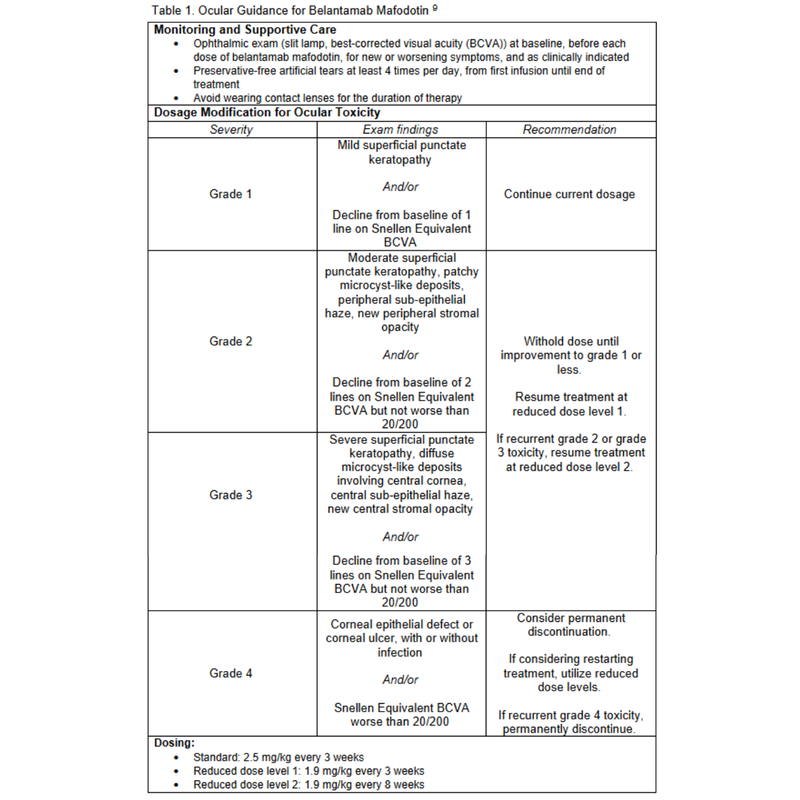
Vigilant monitoring of ocular events is crucial for belantamab mafodotin (Table 1). Although the required monitoring is less intensive than BsAbs or CAR-T therapy, belantamab mafodotin still requires frequent appointments for both drug administration and ocular monitoring, which often necessitates an involved caregiver and may serve as a barrier for some patients. Notably, the current FDA approval requires compliance with a risk evaluation and mitigation strategy (REMS) program which requires prescriber/pharmacy enrollment, ocular toxicity education as well as monitoring and obtaining authorization prior to pharmacy dispensing each dose of belantamab mafodotin. Pharmacists can play a critical role in building the infrastructure and guidance around ocular monitoring and dose modification, as well as patient counseling.
Belantamab Mafodotin: Future Directions
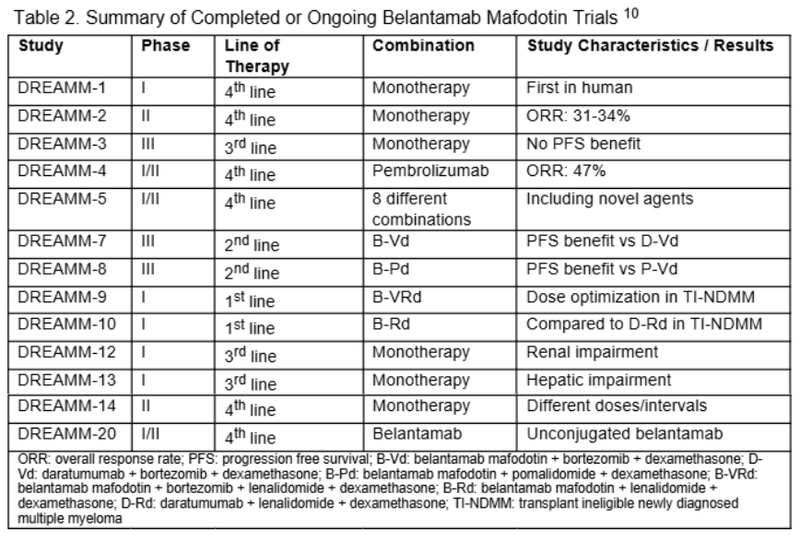
The role of belantamab has evolved since its first approval in 2020, and it will continue to evolve as ongoing trials report findings (Table 2), other BCMA target agents move up in line of therapy and new therapies receive approval. Such studies include the incorporation of belantamab mafodotin in earlier lines of therapy (such as in DREAMM-9 and DREAMM-10), in patients with organ dysfunction (such as in DREAMM-12 and DREAMM-13), and in combination with novel agents (such as in DREAMM-5). Ongoing studies such as DREAMM-9 and DREAMM-14 aim to optimize belantamab mafodotin dosing and scheduling, addressing early concerns about inadequate dose optimization that contributed to prior unfavorable ODAC votes.
Belantamab mafodotin’s reapproval marks a key step forward in BCMA-directed therapy for relapsed or refractory multiple myeloma. Although the absence of ramp-up monitoring may broaden accessibility, vigilant ophthalmic monitoring continues to be a critical component of use. Pharmacists play a vital role in patient selection, monitoring, and education to ensure safe and effective use. Pharmacist involvement is also crucial in developing and implementing standard operating procedures to ensure compliance with the REMS program required by the FDA.
Citations
1.Food and Drug Administration. FDA approves belantamab mafodotin-blmf for relapsed or refractory multiple myeloma. FDA website. Accessed November 18, 2025. https://www.fda.gov/drugs/resources-information-approved-drugs/fda-approves-belantamab-mafodotin-blmf-relapsed-or-refractory-multiple-myeloma
2.Food and Drug Administration. FDA granted accelerated approval to belantamab mafodotin-blmf for multiple myeloma. FDA website. Accessed November 18, 2025. https://www.fda.gov/drugs/resources-information-approved-drugs/fda-granted-accelerated-approval-belantamab-mafodotin-blmf-multiple-myeloma
3.Nooka AK, Cohen AD, Lee HC, et al. Single-agent belantamab mafodotin in patients with relapsed/refractory multiple myeloma: Final analysis of the DREAMM-2 trial. Cancer. 2023;129(23):3746-3760. doi:10.1002/cncr.34987
4.Richardson PG, Jagannath S, Chari A, et al. Overall survival with oral selinexor plus low-dose dexamethasone versus real-world therapy in triple-class-refractory multiple myeloma. EJHaem. 2020;2(1):48-55. Published 2020 Nov 25. doi:10.1002/jha2.120
5.Food and Drug Administration. FDA grants accelerated approval to selinexor for multiple myeloma. FDA website. Accessed November 18, 2025. https://www.fda.gov/drugs/resources-information-approved-drugs/fda-grants-accelerated-approval-selinexor-multiple-myeloma
6.Dimopoulos MA, Hungria VTM, Radinoff A, et al. Efficacy and safety of single-agent belantamab mafodotin versus pomalidomide plus low-dose dexamethasone in patients with relapsed or refractory multiple myeloma (DREAMM-3): a phase 3, open-label, randomised study. Lancet Haematol. 2023;10(10):e801-e812. doi:10.1016/S2352-3026(23)00243-0
7.Hungria V, Robak P, Hus M, et al. Belantamab mafodotin plus bortezomib and dexamethasone in patients with relapsed or refractory multiple myeloma (DREAMM-7): updated overall survival analysis from a global, randomised, open-label, phase 3 trial. Lancet Oncol. 2025;26(8):1067-1080. doi:10.1016/S1470-2045(25)00330-4
8.Meeting of the Oncologic Drug Advisory Committee. FDA. July 17, 2025. Accessed July 17, 2025. https://www.fda.gov/advisory-committees/july-17-2025-meeting-oncologic-drugs-advisory-committee-07172025
9.BLENREP. Package insert. GlaxoSmithKline LLC. October 2025.
10.Driving Excellence in Approaches to Multiple Myeloma (DREAMM). GlaskoSmithKline LLC. Updated April 2025. Accessed November 18, 2025. https://dreammtrials.com/#trials