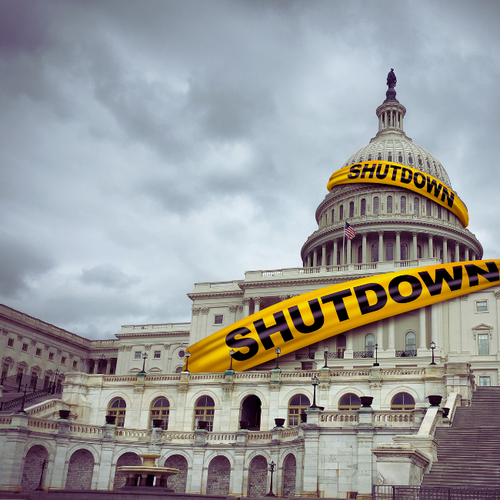
On October 1, 2025, the government shut down after Congress could not reach an agreement on a short-term continuing resolution (CR) or final fiscal year (FY) 2026 appropriations before the September 30 deadline.
This lapse in appropriations triggered a government shutdown, and at this time, it’s unclear when and how Congress will reopen the government. The Democrats are primarily concerned with extending the Affordable Care Act (ACA) Enhanced Premium Tax Credits (i.e., ACA subsidies) before they expire at the end of the calendar year, while the Republicans want to pass a “clean” CR that funds the government at FY25 levels.
The Days Leading up to the Shutdown
Prior to the shutdown, the House passed a CR that ran through November 21 on a partisan basis. It would have funded the government at current levels for an additional seven weeks, giving Congress time to pass final FY 2026 appropriations bills.
Senate Democrats released their own version of a CR that ran through October 31 and addressed health care issues, including extending the ACA subsidies and reversing the Medicaid cuts recently adopted in the One Big Beautiful Bill Act. This alternative failed in the Senate, as did the House-passed version. Subsequent votes have been taken, with no agreement in sight.
House Speaker Mike Johnson (R-LA) sent members home for recess.
What Services will be Impacted?
Activities needed for the safety and protection of property will continue during a shutdown. As we prepare for what may be a lengthy shutdown, here is important information about how Medicare and federal research programs will be affected.
How does the Shutdown Affect Medicare and Medicaid Recipients?
Medicare/Medicaid: Because Medicare and Medicaid are supported by mandatory funding, not annual appropriations, beneficiaries will still be able to access services, and physicians can continue to submit claims, which will be paid. However, those payments may be delayed in a prolonged shutdown.
Medicare Telehealth Services: The Medicare telehealth flexibilities expired on September 30. Therefore, Medicare telehealth rules will revert to those in effect prior to the COVID-19 public health emergency. Only beneficiaries in rural areas will be eligible to travel to a qualified originating site to receive telehealth services.
No Medicare beneficiaries will be able to receive telehealth services in their homes. Additionally, audio-only services will not be covered while this policy has lapsed. Should physicians bill for these services, they will not be reimbursed unless the patient is in a rural area or at a qualified originating site.
How does the Shutdown Affect Cancer and Biomedical Research?
National Institutes of Health (NIH): Both the intramural and extramural research programs will be affected by the shutdown, since employees supporting both programs are furloughed.
Here is a list of NIH activities that will not continue during the shutdown:
- All NIH grant peer review meetings, advisory council meetings, issuance of new awards, and program/grants management activities.
- The admission of new cancer patients at the NIH Clinical Center for clinical trials (unless deemed medically necessary by the NIH Clinical Center Director).
- Initiation of new protocols at the NIH Clinical Center.
- Basic research conducted by NIH scientists.
- Translational research conducted by NIH scientists that develops clinical applications of scientific knowledge.
- Training of graduate students and postdoctoral fellows at NIH facilities.
- Scientific meetings at NIH facilities.
- Travel of NIH scientists to scientific meetings.
- NIH scientific equipment services.
- Almost all NIH administrative functions, including the onboard of non-excepted staff.
Centers for Disease Control and Prevention: CDC will retain about 36 percent of their staff to continue working on responding to urgent outbreaks and keeping up with operations for mandatory programs such as The President’s Emergency Plan for AIDS Relief (PEPFAR), the Vaccines for Children program and the program that provides free medical monitoring and treatment to victims of the 9/11 attacks.
The CDC will not provide guidance for state and local health departments during this time, and there will be no communications with the American public about health-related information, including communications through the Laboratory Outreach Communications System.
Additionally, research on prevention modalities and risk factors will be paused and grant funding announcements will not go out, meaning when the government returns there will be less time for applicants to apply for funding.
How is this Shutdown Different?
The Office of Management and Budget (OMB) released a memo instructing federal agencies to prepare for reductions-in-force (RIF) plans targeting employees who work for programs not legally required to continue or are not consistent with the administration’s priorities. This direction differs from typical shutdown instructions and may be subject to a legal challenge should it be implemented. RIF notifications went out to employees beginning at the end of last week.
What can HOPA Members Do?
The short answer is to keep advocating for all those impacted by cancer and for the role of hematology/oncology pharmacists. Contact your elected officials using pre-written communications found in the HOPA Legislative Action Center.